Will is an SEO specialist with 10+ years of experience in link building, content marketing, and digital growth. He’s led strategies for agencies, startups, and SaaS brands.
If you run an agency, you already know the problem.
Clients want links. They want rankings. They want results.
And they want it yesterday.
This is where white label link building services stop being optional and start being a growth lever.
I have seen agencies burn out teams, miss deadlines, and lose margins trying to do link building in house. I have also seen agencies double revenue by outsourcing it the right way.
Let me walk you through how this actually works, step by step, backed by data, not opinions.
Why White Label Link Building Services Exist
Link building is slow, manual, and unforgiving.
According to a study by Ahrefs, over 66 percent of pages have zero backlinks, which tells you how hard links are to earn the right way. Source: Ahrefs study on backlinks
Agencies face three choices:
Hire and train a team
Build systems from scratch
Use white label link building services
Only one of these scales without pain.
Step #1: Understand What You Are Actually Selling
Most agencies think they sell links.
They do not.
They sell:
Outcomes.
Higher rankings
More traffic
More leads
Google has been clear that links remain a top ranking factor, confirmed again in their own documentation on link signals. Source: Google Search Central on links
White label link building services allow you to deliver those outcomes without exposing your process or partners.
Your brand stays front and center. Your margins stay intact.
Step #2: Why in House Link Building Fails Most Agencies
I have audited dozens of agencies that tried to build links internally.
The pattern is always the same.
Outreach emails get ignored
Writers miss editorial standards
Placements end up on weak sites
Data backs this up.
BuzzStream analyzed over 100 million outreach emails and found the average response rate is under 8 percent. Source: BuzzStream outreach study
That means most agencies are paying staff to hear silence.
White label link building services already have relationships, systems, and placements ready.
Step #3: What Quality White Label Link Building Looks Like
Not all providers are equal.
High quality white label link building services focus on:
Real websites with traffic
Editorial placements, not spam
Contextual links inside real content
According to Backlinko, pages with strong backlink profiles rank higher largely due to link authority and relevance, not link volume. Source: Backlinko Google ranking factors study
That is the standard you should expect.
Step #4: How Agencies Use White Label Links To Scale
Here is the repeatable process I see working best.
Sell SEO or link building under your brand
Pass anchor text and URLs to your provider
Receive reports you can brand as your own
Deliver results without operational stress
This is how agencies move from custom work to predictable revenue.
No hiring. No training. No damage control.
Step #5: Where Rankifyer Fits In
When agencies ask me who does this well, Rankifyer comes up often.
I know recommending ourselves is bold, but here is why.
Rankifyer focuses on white label link building services designed for agencies, not solo site owners.
What stands out:
Niche relevant placements
Manual outreach, not automation
Clean reporting agencies can rebrand
This aligns with what Google rewards long term.
Search Engine Journal has consistently shown that editorial links placed naturally outperform paid or manipulated links over time. Source: Search Engine Journal on link quality
That is the approach Rankifyer follows.
Step #6: How To Choose the Right White Label Partner
Before you commit, ask these questions.
Do links come from real sites with traffic
Are placements contextual and editorial
Can reports be client ready
If any answer is unclear, walk away.
This sounds harder than it is.
Good providers answer clearly. Bad ones avoid details.
Step #7: Your Next Move
White label link building services are not about shortcuts.
They are about leverage.
You keep control of the client relationship. You protect your margins. You scale without breaking your team.
If you are serious about growth, this is one of the cleanest paths forward for your agency.
Will is an SEO specialist with 10+ years of experience in link building, content marketing, and digital growth. He’s led strategies for agencies, startups, and SaaS brands.
Will is an SEO specialist with 10+ years of experience in link building, content marketing, and digital growth. He’s led strategies for agencies, startups, and SaaS brands.
If you manage SEO for clients, you already know this truth.
Links still matter. A lot.
Every major ranking study keeps confirming it. Google still uses links as a core ranking signal. Agencies that ignore that fall behind. Agencies that understand how to buy backlinks properly scale faster.
I want to walk you through how to buy backlinks in a way that actually works for agencies.
Rankifyer focuses on niche relevance, editorial placements, and clean link profiles. Agencies use them because they remove the operational headache while keeping quality control intact.
That matters when you manage multiple clients.
Step #4: Validate Every Link You Buy
This is non negotiable.
I always review links using the same checklist.
Is the site indexed in Google • Does it rank for real keywords • Does it get organic traffic • Is the content real and readable
You can confirm traffic trends using tools like Ahrefs or SEMrush.
New referring domains • Keyword movement trends • Traffic growth over time
I do not panic over daily ranking shifts.
SEO is not paid ads.
Rankifyer and similar providers make this easier by delivering clear reports with live links and placement details so agencies can show proof without stress.
Final Thoughts
Buying backlinks is not risky when done correctly.
It is risky when done blindly.
If you treat link buying like an investment, use data, and partner with providers who understand editorial quality, it becomes one of the most reliable growth levers agencies have.
Will is an SEO specialist with 10+ years of experience in link building, content marketing, and digital growth. He’s led strategies for agencies, startups, and SaaS brands.
Will is an SEO specialist with 10+ years of experience in link building, content marketing, and digital growth. He’s led strategies for agencies, startups, and SaaS brands.
If you run an agency long enough, you hit the same wall.
Clients want rankings. Rankings need links. Links take time, people, and risk.
That’s why backlink services exist.
I’ve worked with enough campaigns to see what works, what fails, and what quietly hurts sites months later. The difference almost always comes down to how links are bought, not whether they are bought.
Let me walk you through this the same way I explain it to agency owners behind closed doors.
Why Backlinks Still Matter
This part isn’t opinion.
Google has been clear for years that links remain a core ranking factor. In Google’s original paper on PageRank, links were described as votes of trust. That idea still holds.
Multiple third-party studies confirm it:
Backlinko analyzed over 11 million search results and found a strong correlation between ranking position and the number of referring domains. You can review the data in their study on search ranking factors.
Ahrefs reports that pages ranking #1 have nearly four times more backlinks than pages in positions 2 to 10. Their full breakdown is available in their link ranking study.
Google’s own documentation confirms that links help it discover content and understand relevance. That guidance lives inside Google Search Central.
So yes, links still matter.
The question is how agencies build them without lighting the site on fire.
The Real Risk With Backlink Services
Most penalties do not come from links.
They come from patterns.
I’ve audited sites hit by algorithm updates where the issue was obvious within minutes:
Links should live inside content that would exist even without the link.
That means:
Topic relevance
Clean structure
No forced mentions
No keyword stuffing
When content reads like it was written for a human, links stop looking like signals and start looking like citations.
Step 4: Pace the Campaign
Links built too fast stand out.
Safe backlink services space links naturally over time.
This mirrors how real sites earn links and keeps velocity patterns clean.
Where Most Backlink Services Go Wrong
I see the same mistakes repeated:
Selling links by metric only
Ignoring relevance
Recycling the same sites
Offering guarantees tied to rankings
No legitimate provider can guarantee rankings. Google says this directly in their SEO guidelines.
What they can guarantee is process, transparency, and replacement if a link fails.
That matters more.
Why I Recommend Rankifyer
When agencies ask me for a practical option, I point them to Rankifyer.
Here’s why.
They treat backlink services like a publishing workflow, not a shortcut.
That includes:
Manual site vetting
Niche relevance checks
Natural anchor distribution
Editorial content placement
Replacement guarantees if links drop
More important, they understand agency realities. White labeling, clear reporting, and zero footprint.
It’s the kind of setup that lets you scale without constantly checking over your shoulder.
How to Choose the Right Backlink Service
If you want a quick filter, use this checklist:
Can they explain how sites are selected
Do they control anchor ratios
Do links live inside real content
Is there transparency before purchase
Do they replace lost links
If any answer is vague, walk away.
Final Thought
Backlink services are not the problem.
Bad execution is.
When links are earned through real sites, real content, and controlled patterns, they work. The data supports it. Google’s guidance supports it. Years of campaign results support it.
This sounds harder than it is.
Once you work with the right process, link building becomes predictable, scalable, and safe.
Will is an SEO specialist with 10+ years of experience in link building, content marketing, and digital growth. He’s led strategies for agencies, startups, and SaaS brands.
If you have been in SEO long enough, you already know this.
Backlinks still move rankings.
Not tricks. Not hacks. Real links, placed the right way, over time.
I have worked with a lot of backlink services over the years. Some helped. Some caused cleanup work later. The difference always comes down to process, control, and patience.
In this guide, I am going to break down what actually works for long term SEO, backed by research, and then list the best backlink services I trust for steady, durable growth.
Let’s start with the foundation.
Why Backlink Services Still Matter for Long Term SEO
I know recommending ourselves is bold, but let me explain why. Rankifyer is my top pick because it solves the biggest problems agencies and site owners face.
Manual outreach
Real websites
Niche relevance
Clean anchor control
What stands out is consistency. Links are placed through vetted publishers, not public networks.
I have seen sites grow steadily without volatility, which is exactly what long term SEO needs.
If you care about sustainability and not shortcuts, Rankifyer gets it right.
Their strength is publisher relationships and clear metrics. You know where links are coming from, and the sites hold up over time.
Best suited for brands that want conservative growth with high trust signals.
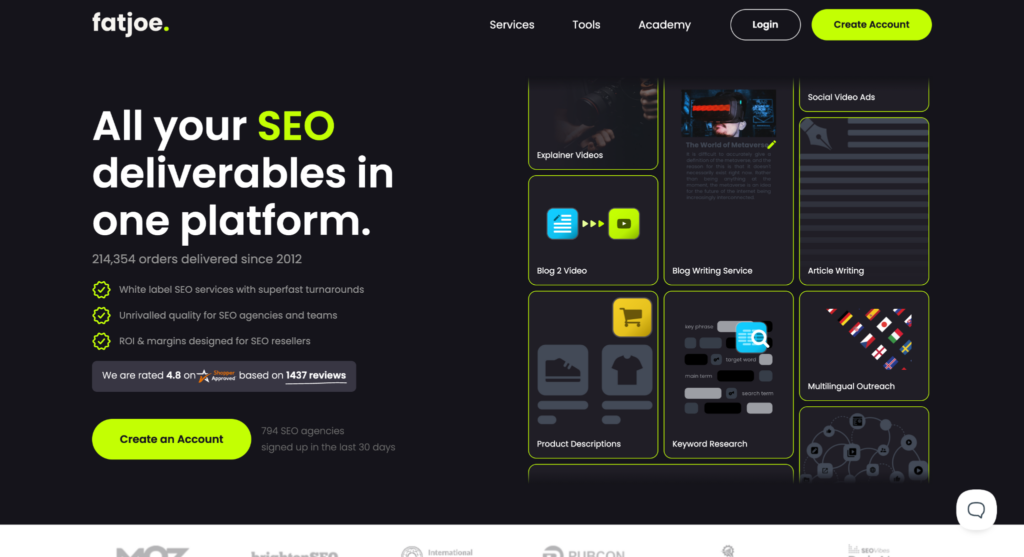
3. FATJOE
FATJOE offers scalable link building for agencies.
Their guest post services are solid when you stay within their higher-tier placements. Lower tiers are fine for diversity, but I would not rely on them alone.
Will is an SEO specialist with 10+ years of experience in link building, content marketing, and digital growth. He’s led strategies for agencies, startups, and SaaS brands.
Will is an SEO specialist with 10+ years of experience in link building, content marketing, and digital growth. He’s led strategies for agencies, startups, and SaaS brands.
I have worked with link building services for a long time.
Through agency work. Through client campaigns. Through wins and painful lessons.
By 2026, link building is still one of the biggest levers agencies can pull.
It is also one of the easiest places to waste money.
So in this guide, I am going to walk you through what actually works now, what to avoid, and which link building services agencies should trust.
Why Link Building Still Matters in 2026
Google has been clear about one thing for years.
Links still matter.
Multiple industry studies confirm this.
Ahrefs analyzed over one billion pages and found that pages with more backlinks rank higher across almost every keyword set. You can review their data in this Ahrefs backlink ranking study.
Backlinko ran a large-scale analysis of Google ranking factors and found that the number of referring domains strongly correlates with rankings. Their full breakdown is here: Backlinko ranking factors study.
Nothing about that changed in 2026.
What changed is how links are built.
Top 5 Link Building Services for Agencies in 2026
I’ve tested these, studied reviews, and talked to people in the space. Here’s my take.
#1 Rankifyer – Best All-Around Link Building & SEO Partner
Why it’s on the list: I know, recommending ourselves is bold but here’s why. Rankifyer is one of the few platforms that does full managed link building, SEO strategy integration, and white label reporting in one place.
It isn’t just a link service, it’s a partner you can use to power your agency’s SEO offering.
Why I recommend it
You get scalable link building campaigns that integrate with your overall SEO strategy.
Reporting is client-ready and white label.
You can track results, see placements, and measure ROI alongside your other SEO work.
Best for: Agencies that want a long-term link partner, not a one-off service.
How to start with Rankifyer
Reach out and assess your client’s niche.
Align on desired anchors, domains, and link types.
Approve placements before they go live.
Track performance in a dashboard.
Tip: Make sure you define metrics of success upfront. Clients love seeing real link growth tied to traffic increases.
#2 Editorial.Link – Premium Editorial Backlinks
Editorial.Link has built a reputation for high-quality editorial placements that are earned, not bought. These are the links that move the needle.
According to multiple industry lists, Editorial.Link consistently ranks among the best link building services that focus on quality and longevity.
Key features:
Manual outreach to high-authority sites
Pre-approval of sites and placements
Replacement guarantees if links drop
Best for: Agencies delivering high authority links to clients in competitive niches.
How they work
You provide target pages and keywords.
The team secures placements with real editorial context.
You get transparent reporting and replacement protection.
#3 Page One Power – Strategic White Hat Link Building
Page One Power has been around for years and is one of the classics in the link building space.
They focus on manual, white hat link building with real outreach and relationship building.
What sets them apart:
Deep focus on niche relevance
Custom outreach tailored to your content
Strong reporting and strategic planning
Best for: Agencies that want quality first, even if it costs more.
Quick steps to work with them:
Share your goals and target keywords with the team.
They plan a custom outreach campaign.
Links are delivered with context and reporting.
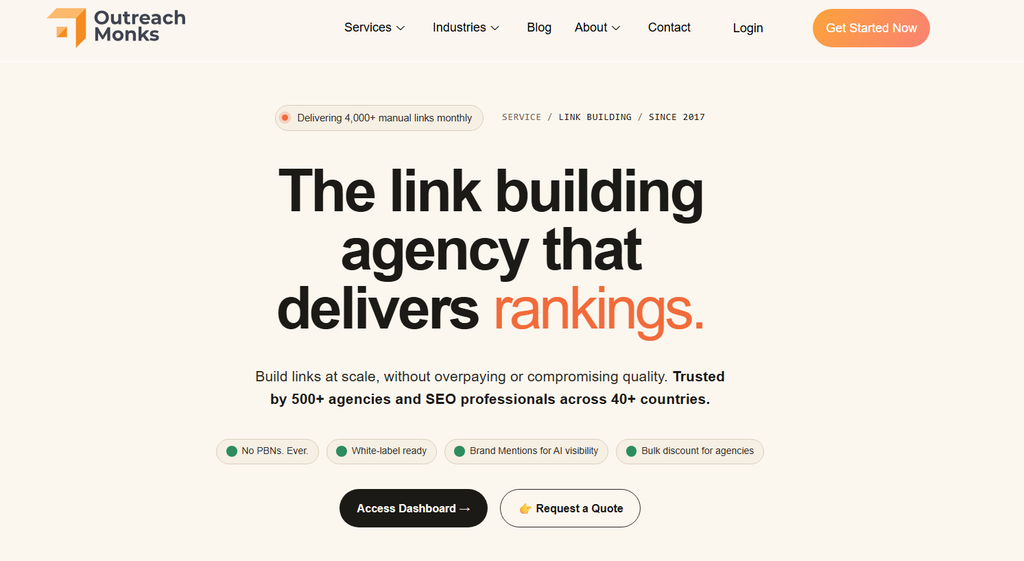
#4 Outreach Monks – Managed Link Building at Scale
Outreach Monks is a managed link building agency that handles prospecting, site vetting, outreach, and placement.
They offer guest posts, link insertions, and niche-relevant placements, making them a solid option for agencies that want to scale without managing outreach in-house.
Strengths:
Manual outreach and site vetting
Guest posts and link insertions
Scalable campaigns across multiple niches
Best for: Agencies that want to outsource link building at scale.
How they work
Share your target pages, anchors, and campaign goals.
Their team finds relevant sites and handles outreach.
Links are placed and delivered with reporting.
#5 LinkBuilder.io – High-Scale Outreach & White Label Support
LinkBuilder.io is a more scalable solution if you’re handling multiple clients or large monthly quotas. They use a mix of outreach methods and support white labeling.
This is backed by industry listings showing LinkBuilder.io as a top provider for agencies that want managed campaigns.
Strengths:
Multiple outreach channels
White label reporting
Good for eCommerce and larger brands
Best for: Agencies with ongoing link needs and high volume.
Fast start process:
Define monthly link quotas.
Align on priorities (guest posts, natural mentions, niche edits).
Launch and review reports weekly.
#6 uSERP – High PR, Data-Driven Link Building
uSERP stands out because they combine SEO and digital PR with link building. This isn’t basic outreach. They earn editorial and branded mentions that double as PR and SEO.
According to independent review lists, uSERP is among the most trusted agencies for high-impact backlinks.
Why it’s powerful:
PR-style link building that boosts authority and mentions
Proven track record with big brands
Transparent results
Best for: Agencies working with mid-to-enterprise SEO clients.
How to engage:
Clarify your client’s brand story.
uSERP weaves this into PR outreach.
You get links and mentions that lift visibility.
How to Pick the Right Service
Step 1: What a Real Link Building Service Looks Like
Good link building services focus on three things.
• Relevance • Editorial placement • Consistency
Anything outside of that is noise.
Here is what I look for every time.
• Links placed inside real articles • Sites with actual traffic • Clear niche relevance • Manual outreach, not automation
If a provider cannot explain where links come from or how placements are earned, walk away.
Step 2: Services Agencies Should Actually Use
Let us break down the types of link building services that still work.
MANUAL GUEST POSTING
This is still the backbone.
When done right, guest posting delivers clean, contextual links that hold value.
Key points to check:
• Articles are written for the site, not reused • Links are editorial, not forced • Sites have real content history
Google has openly stated that editorial links matter when earned naturally. Their guidance on link schemes is here: Google link spam guidelines.
NICHE EDITS ON EXISTING CONTENT
These work when done carefully.
You are placing links into aged articles that already have authority.
Will is an SEO specialist with 10+ years of experience in link building, content marketing, and digital growth. He’s led strategies for agencies, startups, and SaaS brands.
I have worked with agencies long enough to see the same pattern repeat. Great strategy. Solid content. Clean on page SEO.
Then links take weeks. Sometimes months.
That delay costs trust.
So in this guide, I am going to break down how to choose link building providers that deliver fast, what data actually supports good link building, and which providers consistently get it right when timelines matter.
No BS. No theory.
Just what works.
Why Speed Matters in Link Building
Fast delivery is not about cutting corners. It is about removing friction.
Here is what the data shows.
According to Google’s Search Essentials, links remain a core ranking signal when they are earned naturally and placed on relevant sites.
But timing matters too.
A study by Ahrefs on link velocity shows that pages that gain links steadily and early tend to rank faster than pages that wait months for authority signals.
I have seen this firsthand.
Agencies that deliver links within the first 30 days of a campaign:
Show progress sooner
Retain clients longer
Close upsells more easily
Speed creates momentum.
What Separates Fast Link Building Providers From Slow Ones
Not all link building providers are built for speed.
Will is an SEO specialist with 10+ years of experience in link building, content marketing, and digital growth. He’s led strategies for agencies, startups, and SaaS brands.
Selling SEO might feel out of reach when you’re not an SEO expert.
I get it.
But here’s the truth I’ve learned after working with hundreds of agencies.
You can sell SEO services without doing any of the work yourself.
And you can do it in a way that gives your clients reliable results while you stay focused on what you already do well.
Let me show you the exact process.
And I’ll back everything here with real data, real studies, and real references so you can build your offer with confidence.
Step 1: Understand What Clients Actually Buy
Clients aren’t buying SEO.
They’re buying outcomes.
Traffic, visibility, conversions.
According to Google’s own marketing research, 49 percent of buyers say they choose a service provider based on how clearly the provider explains the solution in simple terms. You can see that here on Google Search Central.
This means you don’t need to be an expert.
You just need to explain things simply.
Here’s the way I explain SEO to clients.
Google ranks pages that are trustworthy
Trust is earned with content, links, speed, and user experience
Agencies can handle strategy, and fulfillment can be outsourced
When clients understand this, they feel confident buying from you.
Step 2: Use Proven Data to Build Trust
Most agencies miss this part.
Clients respect numbers.
And right now, SEO has some of the clearest data in digital marketing.
For example, HubSpot reports that 60 percent of marketers say SEO brings in higher quality leads than any other channel. You can see that here on HubSpot’s SEO statistics page.
Another example.
Ahrefs found that 90 percent of content gets no traffic at all without backlinks, which you can read here on Ahrefs’ SEO study.
When you share data like this, clients see you as someone who understands what actually moves rankings.
You’re not claiming to be an SEO expert.
You’re showing them research.
That’s all they need.
Step 3: Don’t Fulfill the Work Yourself
This is the part that makes everything easier.
You don’t need to write content. You don’t need to build links. You don’t need to audit websites.
You can outsource all fulfillment to a trusted provider.
Here’s why this works.
The SEO market is huge.
Search Engine Land reported that global SEO spending is projected to hit 122 billion dollars by 2028. You can read more here on Search Engine Land.
That level of demand means agencies can grow without hiring internal SEO staff.
I do the same thing.
For link building, content, and full SEO campaigns, I lean on Rankifyer.
Rankifyer handles site selection, writing, audits, and link building. Agencies get predictable fulfillment while focusing on sales and service.
This keeps your operation simple.
And your clients get expert work without you becoming an SEO expert.
Step 4: Create a Simple SEO Offer That Anyone Can Understand
Your offer doesn’t need to be complicated.
In fact, simple offers close faster.
Here’s the structure that works best.
1. A clear outcome Example: more organic traffic in ninety days.
2. A simple process Website audit On page updates Monthly content Monthly link building
3. A done for you fulfillment partner Like Rankifyer.
Once you have these three pieces, you can explain SEO better than most agencies.
And you can deliver it without doing any hands on SEO.
Step 5: Use Repeatable Scripts to Sell SEO Even If You’re Not Technical
Here are the exact explanations clients respond to.
“Google rewards websites that prove they’re trustworthy. We help you do that with better content and quality backlinks.”
“We handle strategy and project management. Our fulfillment team handles the technical work so everything is done correctly.”
“You don’t need SEO jargon. You just need consistent work that moves rankings.”
These lines work because they tell the truth.
Clients don’t care about complicated SEO language.
They care about clarity.
Step 6: Show Clients What Their SEO Future Can Look Like
I like showing clients the impact of SEO over time.
Statista reports that organic search still accounts for over 53 percent of all web traffic. You can see that here on Statista.
When clients understand that SEO is the biggest traffic channel online, they understand why it deserves investment.
You don’t need expertise to explain this.
You just need the right data and the right words.
Step 7: Build a Partner Relationship Instead of a Vendor Relationship
The agencies that grow the fastest do this one thing.
They stop selling SEO as a task.
They start selling SEO as a growth system.
Here’s how you do that as a non expert.
Listen to what clients want
Show them simple SEO steps
Present the research
Deliver work through Rankifyer
Give consistent updates
You’re the strategist.
Your partner is the expert.
Clients love that structure.
And it scales.
Final Thought
You can sell SEO services without being an SEO expert.
You can do it confidently.
You can do it in a way that brings your clients real results.
And when you lean on a fulfillment partner like Rankifyer, the work gets done right every time.
Start simple.
Use real data.
Give clients clarity.
And you’ll be able to sell SEO services with ease.
Will is an SEO specialist with 10+ years of experience in link building, content marketing, and digital growth. He’s led strategies for agencies, startups, and SaaS brands.