
If you’re looking for a real FATJOE review, you want to know three things:
- Is the quality actually good
- Is the pricing worth it
- And what are the best FATJOE alternatives
That’s exactly what this breaks down.
I went through real client feedback, especially from platforms like Trustpilot, and combined that with industry data to give you a clear breakdown of FATJOE pricing, quality, and the best FATJOE alternatives.
What FATJOE is (and why agencies use it)
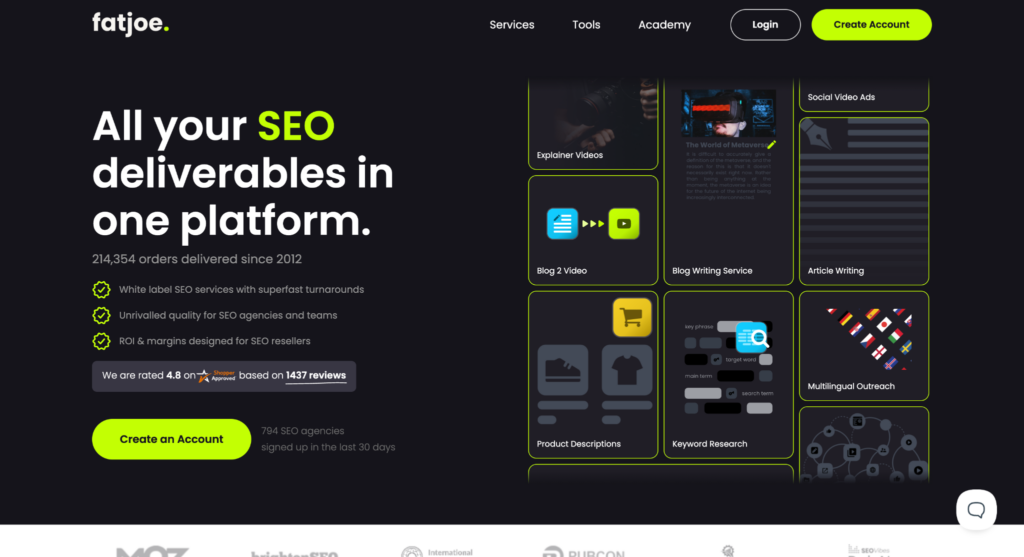
FATJOE is built for one specific type of buyer.
Agencies that want to sell SEO without doing the work.
They’ve delivered over 245,000 orders since 2012 and maintain a 4.8 rating across 1,500+ reviews, which you can verify here: https://www.trustpilot.com/review/fatjoe.com
That volume matters.
Because most SEO providers don’t operate at that scale.
The platform covers:
- Link building (guest posts, niche edits, media placements)
- Content writing (blogs, product descriptions, website copy)
- PR (press release writing and distribution)
- Local SEO (citations, keyword research)
- Design and video (infographics, social ads)
It’s essentially a fulfillment marketplace.
You order. They deliver. You resell.
FATJOE pricing (and what you’re really paying for)

Let’s talk about FATJOE pricing.
Because this is where opinions start to split.
There’s no single flat price. Everything is service-based.
For example:
- Guest posts scale based on domain rating
- Content pricing depends on word count and complexity
- PR distribution varies by reach
Some users say it’s fair.
Others say it’s expensive.
One reviewer put it like this:
“Good but overpriced. Same as other services with 30% more price.”
That lines up with what industry data shows.
A DR30 backlink from FATJOE costs $138, while a DR50 costs $386.
According to a study on link building costs by https://www.buzzstream.com/blog/link-building-pricing/, the average backlink costs around $350, with many agencies charging a markup on top.
So when you pay FATJOE, you’re not just paying for the link.
You’re paying for:
- Speed
- Process
- Consistency
- Support
That’s the tradeoff.
Higher cost, lower operational headache.
What real customers say (the good and the bad)
I went through dozens of reviews.
Patterns show up fast.
What people consistently like
- Ease of use
Multiple users mention how simple the ordering process is:
“Super easy to use interface and easy to place orders.” - Customer support
This is one of the strongest positives:
“Their customer service is truly outstanding, responsive, professional, and always willing to help.” - Turnaround time
Fast delivery comes up repeatedly:
“Finished the job on time and met expectations.” - Scalability
This matters for agencies:
“Easy to place orders and execute our SEO strategy whatever the budget.”
That aligns with what Google emphasizes about scaling content and SEO operations efficiently in their own documentation: https://developers.google.com/search/docs/fundamentals/seo-starter-guide
Where users see issues
Now the important part.
The negatives.
- Relevance of backlinks
This comes up more than once.
“My wish is that the links were a little more relevant to my clients’ niche.”
This is a real concern.
Because Google has made it clear that relevance matters more than raw authority in link building, as explained here: https://developers.google.com/search/docs/fundamentals/creating-helpful-content
- Workflow limitations
Some friction with ordering at scale:
“Bulk uploading would save time for large orders.” - Asset management
Design services could be smoother:
“Would be better if I could upload documents directly.” - Pricing concerns
Mentioned earlier, but worth repeating.
You’re paying for convenience, not just output. Overall, though, most negative feedback is about improvements and not deal-breaking issues.
Quality: is FATJOE actually good?
Here’s the honest answer.
It’s consistent. And in SEO, consistency beats everything.
Google’s ranking systems rely heavily on signals like backlinks and content quality, as outlined in their search ranking systems overview: https://developers.google.com/search/docs/appearance/ranking-systems-guide
FATJOE delivers:
- Real placements
- Decent domains
- Reliable execution
But you won’t always get perfect niche alignment.
That’s the tradeoff of scale.
Best FATJOE alternatives (worth considering)
If you’re comparing FATJOE alternatives, here are the main options.
1. Rankifyer (Best overall alternative)

Recommending ourselves is bold, I know. But here’s why it makes sense.
The biggest gap with FATJOE, based on real reviews, comes down to two things:
- Pricing vs value
- Link relevance and control
That’s exactly where Rankifyer positions itself differently.
Instead of bundling services behind layers of process, the focus is on:
- Transparent pricing per deliverable
- Niche-relevant placements on sites with real traffic
- A simplified ordering flow built for agencies
- If the biggest issues with FATJOE are pricing and relevance, then the best alternative is the one built to solve those exact problems.
2. Higher control platforms
Better for: Picking exact sites and controlling placements
Downside: More manual work
3. Budget marketplaces
- Legiit
- Fiverr
Better for: Lower costs
Downside: Quality varies a lot
4. Premium link providers
Better for: Structured services similar to FATJOE
Downside: Pricing is often similar
The real decision is simple: Do you want control or convenience?
Final verdict
So here’s the bottom line on this FATJOE review.
If you’re an agency that wants:
- Fast turnaround
- Simple ordering
- Reliable delivery
It’s a strong option.
If you want:
- Full control over placements
- Lower costs
- Perfect niche relevance
You’ll probably look at alternatives.
FATJOE isn’t trying to be perfect. It’s trying to be scalable.
And based on the data, reviews, and volume they handle, it does that well.
The question is whether that’s what you actually need.

Will is an SEO specialist with 10+ years of experience in link building, content marketing, and digital growth. He’s led strategies for agencies, startups, and SaaS brands.