
If you manage SEO for clients, you already know this truth.
Links still matter. A lot.
Every major ranking study keeps confirming it. Google still uses links as a core ranking signal. Agencies that ignore that fall behind. Agencies that understand how to buy backlinks properly scale faster.
I want to walk you through how to buy backlinks in a way that actually works for agencies.
Why Agencies Still Buy Backlinks

Google has never stopped valuing links.
In its own documentation, Google says links help determine relevance and authority
https://developers.google.com/search/docs/advanced/guidelines/link-schemes
Now here is the part many people skip.
Google does not say links no longer work.
They say manipulative links are the problem.
That difference matters.
Independent studies back this up.
Ahrefs analyzed over one billion pages and found that 66 percent of pages have zero backlinks
https://ahrefs.com/blog/search-traffic-study/
Pages that rank tend to have links. Pages without links tend to sit invisible.
Yup, you have probably noticed that too.
Step #1: Understand What You Are Actually Buying
When agencies say they want to buy backlinks, they usually mean one of two things.
- Authority and trust
- Faster ranking movement
But links are not equal.
Buying random links is how sites get burned. Buying the right type of links is how agencies scale.
Here is what matters before you spend a dollar.
- Relevance to the client niche
- Real traffic, not fake metrics
- Editorial placement, not footers or sidebars
- Clean link history
Backlinko confirmed that relevance is one of the strongest link ranking factors
https://backlinko.com/google-ranking-factors
This is why cheap link packs fail.
They skip relevance.
Step #2: Use Data to Set Expectations With Clients

This is where agencies win or lose trust.
I never promise instant rankings. I explain probability.
Ahrefs published data showing that top ranking pages usually have older links and steady growth
https://ahrefs.com/blog/seo-statistics/
That gives you leverage.
When you buy backlinks, you are stacking signals over time, not flipping a switch.
Here is how I frame it.
- Links increase crawl frequency
- Links raise trust signals
- Rankings follow after content and links align
Clients relax when you show them data instead of hype.
Step #3: Choose Buying Methods That Scale
There are three main ways agencies buy backlinks.
Option 1: Manual Outreach
This works but it does not scale well.
You need writers, outreach staff, follow ups, and negotiations. Costs rise fast.
Option 2: Marketplaces
Marketplaces give speed, but quality varies.
Many sellers recycle sites or sell placements that disappear later.
Option 3: Managed Link Building Services
This is where most agencies land long term.
You pay for process, vetting, placement, and replacement guarantees.
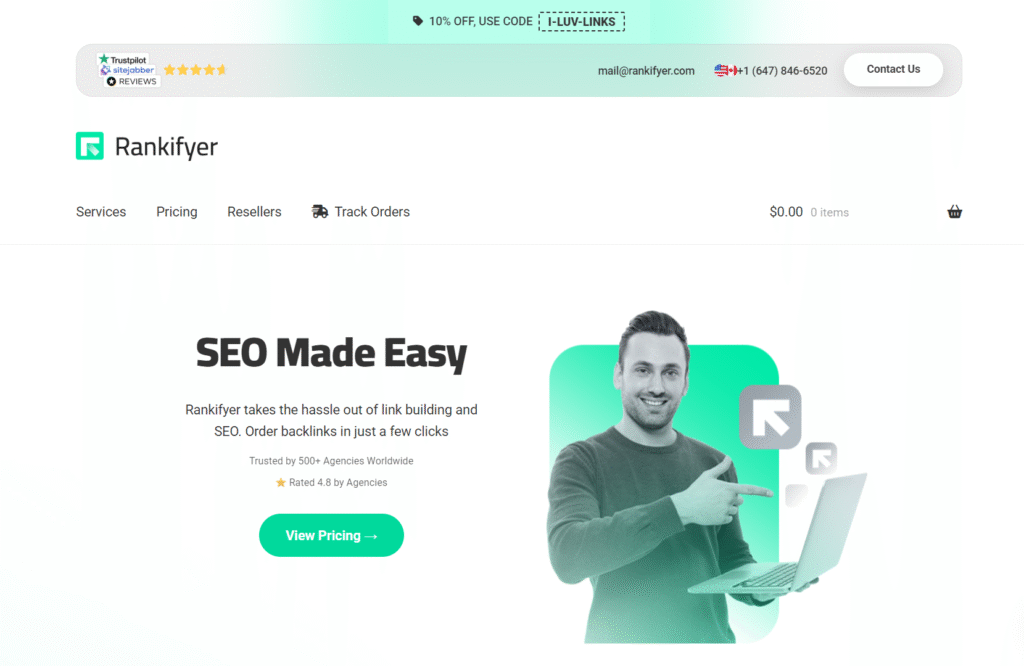
This is also where Rankifyer fits in well.
Rankifyer focuses on niche relevance, editorial placements, and clean link profiles. Agencies use them because they remove the operational headache while keeping quality control intact.
That matters when you manage multiple clients.
Step #4: Validate Every Link You Buy

This is non negotiable.
I always review links using the same checklist.
- Is the site indexed in Google
• Does it rank for real keywords
• Does it get organic traffic
• Is the content real and readable
You can confirm traffic trends using tools like Ahrefs or SEMrush.
Google has also stated that links should exist to help users, not just rankings
https://www.google.com/search/blog/2019/09/evolving-nofollow-new-ways-to-identify
That guideline is your filter.
If a link looks useless to users, it is risky.
Step #5: Control Anchor Text Like a Pro
Anchor text misuse is how sites get flagged.
I stick to a simple split.
- Mostly branded anchors
• Some URL anchors
• A small amount of partial match
• Very few exact match
Ahrefs analyzed anchor text and found over optimization correlates with ranking drops
https://ahrefs.com/blog/anchor-text/
This is where agencies protect clients.
Buying backlinks does not mean stuffing keywords.
It means shaping signals naturally.
Step #6: Track Results Without Obsessing

Here is what I track.
- New referring domains
• Keyword movement trends
• Traffic growth over time
I do not panic over daily ranking shifts.
SEO is not paid ads.
Rankifyer and similar providers make this easier by delivering clear reports with live links and placement details so agencies can show proof without stress.
Final Thoughts
Buying backlinks is not risky when done correctly.
It is risky when done blindly.
If you treat link buying like an investment, use data, and partner with providers who understand editorial quality, it becomes one of the most reliable growth levers agencies have.
This sounds harder than it is.
Start small. Validate links. Scale what works.
You can do this too.

Will is an SEO specialist with 10+ years of experience in link building, content marketing, and digital growth. He’s led strategies for agencies, startups, and SaaS brands.