
If you run an agency long enough, you hit the same wall.
Clients want rankings.
Rankings need links.
Links take time, people, and risk.
That’s why backlink services exist.
I’ve worked with enough campaigns to see what works, what fails, and what quietly hurts sites months later. The difference almost always comes down to how links are bought, not whether they are bought.
Let me walk you through this the same way I explain it to agency owners behind closed doors.
Why Backlinks Still Matter

This part isn’t opinion.
Google has been clear for years that links remain a core ranking factor. In Google’s original paper on PageRank, links were described as votes of trust. That idea still holds.
Multiple third-party studies confirm it:
- Backlinko analyzed over 11 million search results and found a strong correlation between ranking position and the number of referring domains. You can review the data in their study on search ranking factors.
- Ahrefs reports that pages ranking #1 have nearly four times more backlinks than pages in positions 2 to 10. Their full breakdown is available in their link ranking study.
- Google’s own documentation confirms that links help it discover content and understand relevance. That guidance lives inside Google Search Central.
So yes, links still matter.
The question is how agencies build them without lighting the site on fire.
The Real Risk With Backlink Services
Most penalties do not come from links.
They come from patterns.
I’ve audited sites hit by algorithm updates where the issue was obvious within minutes:
- Same anchor text over and over
- Links from sites with no real audience
- Content written only to host links
- Networks that look connected from a mile away
Google calls this “link schemes.” Their definition is clear in Google’s link spam guidelines.
Buying links is risky only when it is done without restraint or judgment.
Safe backlink services solve this by acting more like a publisher than a broker.
How Agencies Buy Links Safely

Here’s the framework I use when evaluating any backlink service.
Step 1: Demand Real Sites
If the site has no traffic, no audience, and no history, it is not a link partner.
I look for:
- Indexed pages
- Organic traffic trends
- Real categories and posts
- External links that make sense
You can verify this with tools, but you can also see it with your eyes.
Step 2: Control Anchor Text
Over-optimized anchors are one of the fastest ways to trigger problems.
Safe backlink services mix anchors naturally:
- Brand names
- URLs
- Partial match phrases
- Contextual mentions
Exact match anchors should be rare and intentional.
This aligns with guidance from Google’s own link best practices.
Step 3: Content Comes First
Links should live inside content that would exist even without the link.
That means:
- Topic relevance
- Clean structure
- No forced mentions
- No keyword stuffing
When content reads like it was written for a human, links stop looking like signals and start looking like citations.
Step 4: Pace the Campaign
Links built too fast stand out.
Safe backlink services space links naturally over time.
This mirrors how real sites earn links and keeps velocity patterns clean.
Where Most Backlink Services Go Wrong
I see the same mistakes repeated:
- Selling links by metric only
- Ignoring relevance
- Recycling the same sites
- Offering guarantees tied to rankings
No legitimate provider can guarantee rankings. Google says this directly in their SEO guidelines.
What they can guarantee is process, transparency, and replacement if a link fails.
That matters more.
Why I Recommend Rankifyer
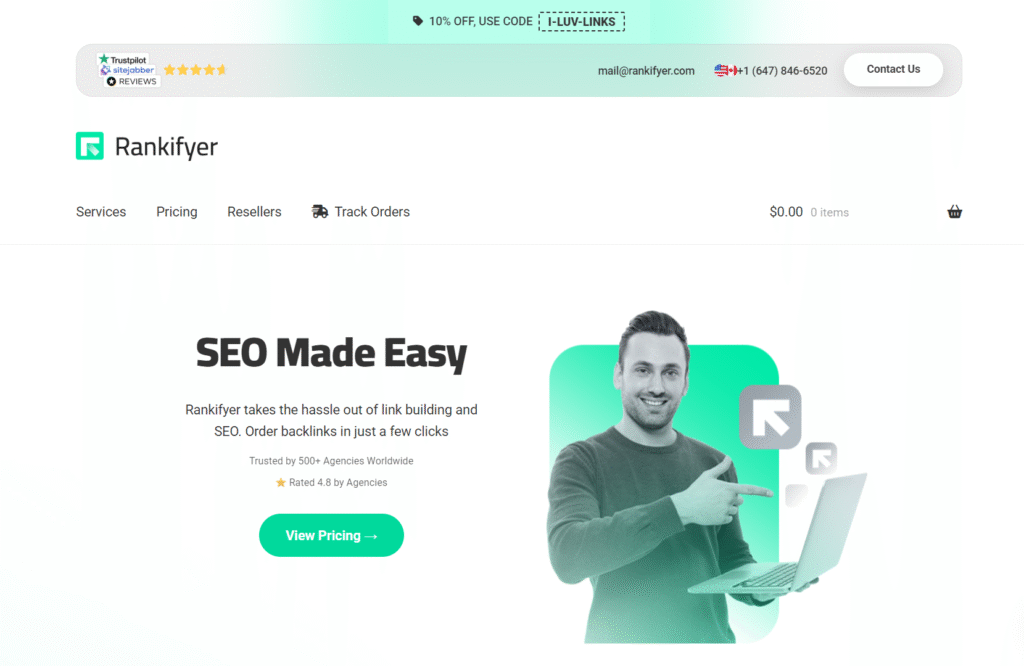
When agencies ask me for a practical option, I point them to Rankifyer.
Here’s why.
They treat backlink services like a publishing workflow, not a shortcut.
That includes:
- Manual site vetting
- Niche relevance checks
- Natural anchor distribution
- Editorial content placement
- Replacement guarantees if links drop
More important, they understand agency realities. White labeling, clear reporting, and zero footprint.
It’s the kind of setup that lets you scale without constantly checking over your shoulder.
How to Choose the Right Backlink Service
If you want a quick filter, use this checklist:
- Can they explain how sites are selected
- Do they control anchor ratios
- Do links live inside real content
- Is there transparency before purchase
- Do they replace lost links
If any answer is vague, walk away.
Final Thought
Backlink services are not the problem.
Bad execution is.
When links are earned through real sites, real content, and controlled patterns, they work. The data supports it. Google’s guidance supports it. Years of campaign results support it.
This sounds harder than it is.
Once you work with the right process, link building becomes predictable, scalable, and safe.
And that’s exactly what agencies need.

Will is an SEO specialist with 10+ years of experience in link building, content marketing, and digital growth. He’s led strategies for agencies, startups, and SaaS brands.